
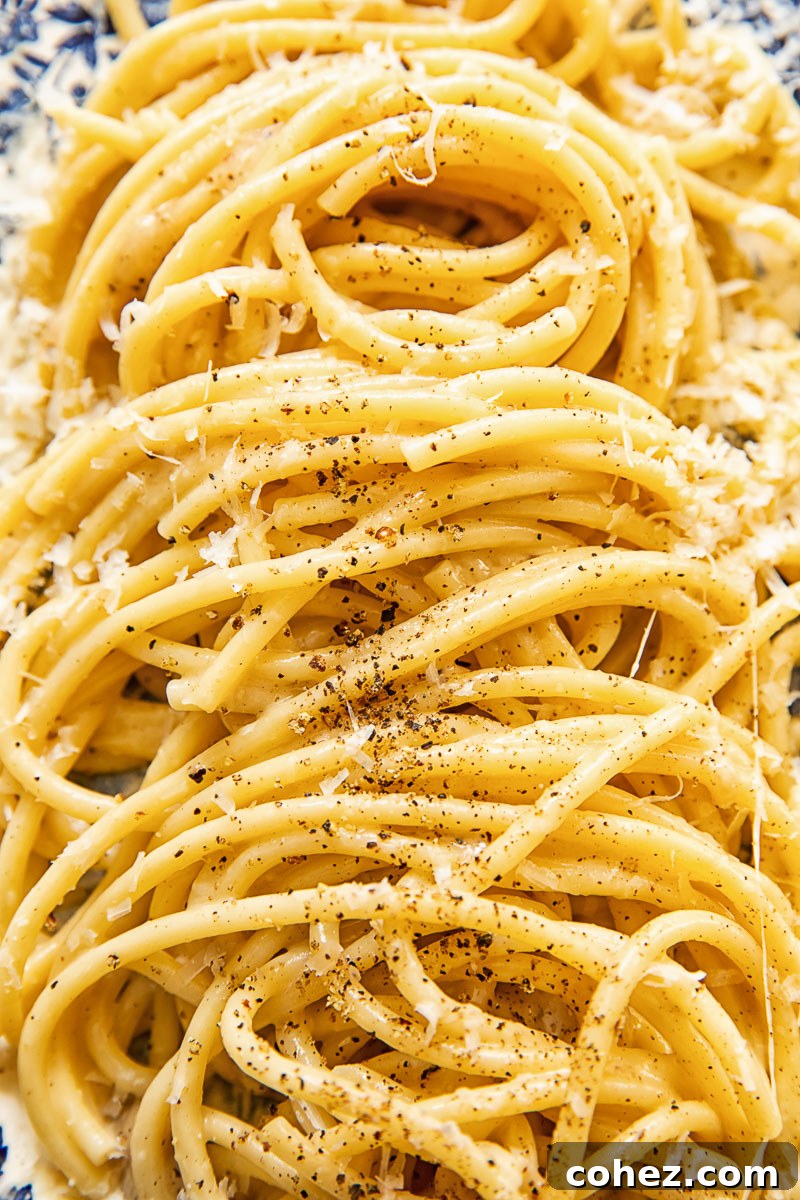
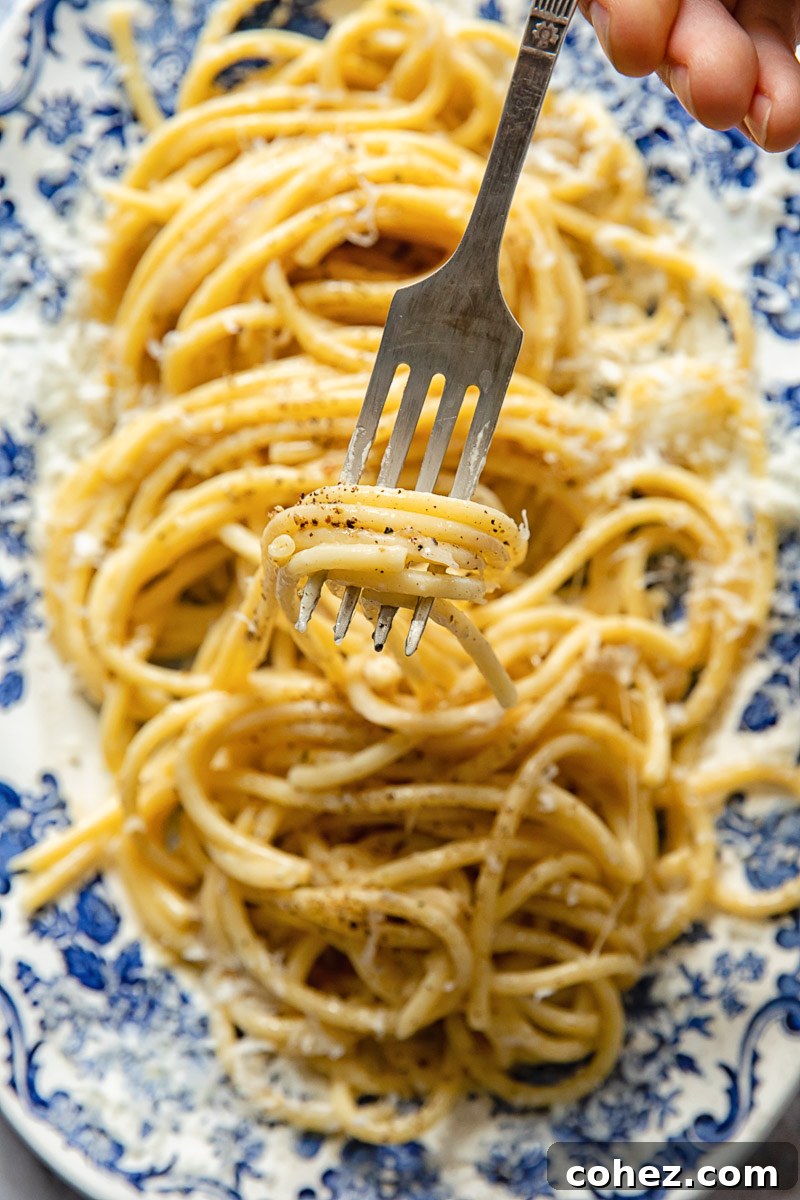
Dive into the heart of Roman culinary tradition with Bucatini Cacio e Pepe, a dish that proves elegance can indeed be found in simplicity. This iconic pasta, featuring sharp Pecorino Romano cheese and freshly cracked black pepper, creates an irresistibly creamy sauce that coats every strand of bucatini. Far from the typical tomato-based pasta, Cacio e Pepe offers a sophisticated, yet incredibly quick, alternative that will transport your family to the vibrant streets of Rome in under 30 minutes. Prepare to master a true Italian classic.
In Italy, pasta is often enjoyed as a modest, flavorful first course, a prelude to the main event, rather than the expansive, gut-busting portions many of us are accustomed to. Embracing this authentic Roman dining philosophy, I encourage you to serve this exquisite pasta dish as a delightful starter, perhaps followed by a delectable second course. Consider pairing it with prosciutto-wrapped creamy pesto chicken parcels for a truly memorable Italian-inspired meal.
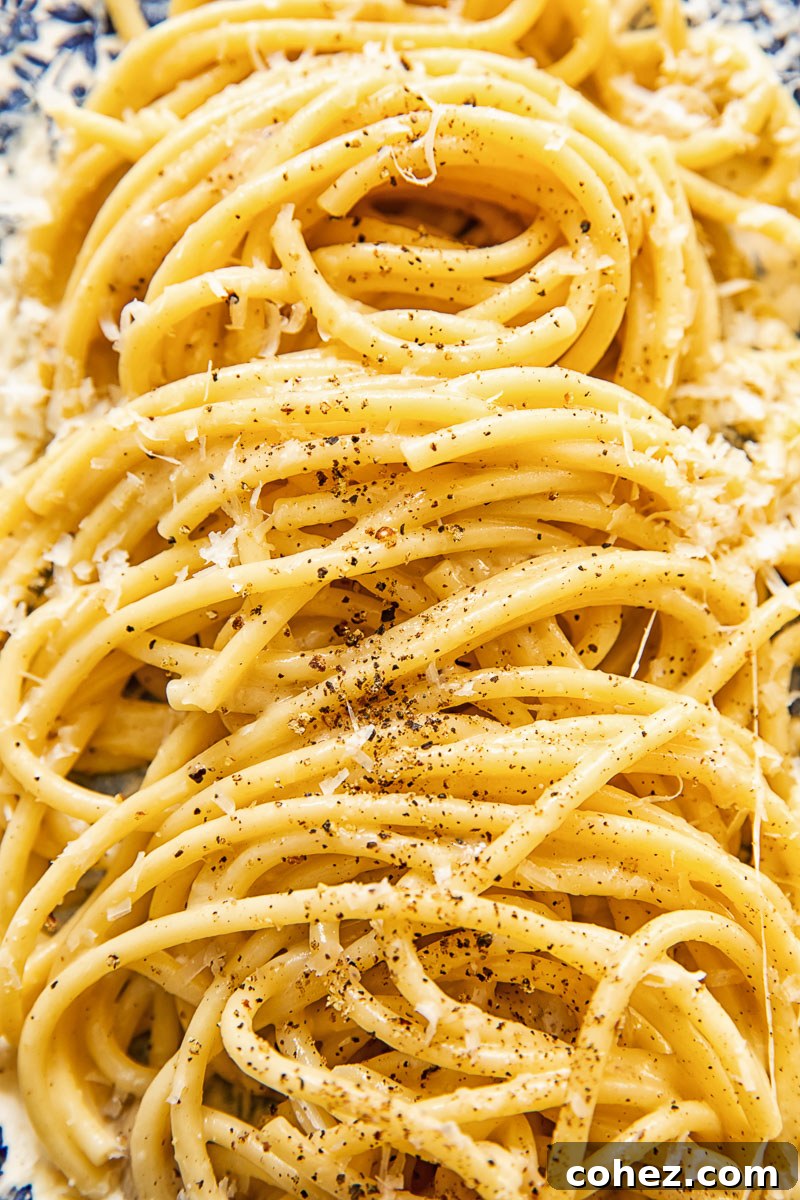
Unveiling Cacio e Pepe: A Timeless Roman Classic
The name “Cacio e Pepe” itself reveals the soul of this dish: “cacio” refers to cheese (specifically Pecorino Romano in Rome) and “pepe” means pepper. Like many beloved culinary staples across the globe, Cacio e Pepe likely originated from humble, rustic beginnings. Imagine ancient Roman shepherds, tending their flocks on sun-drenched hillsides, relying on simple, non-perishable ingredients they carried with them: dried pasta, hard cheese, and black pepper. These accessible ingredients, combined with its intensely satisfying flavor profile, allowed Cacio e Pepe to rise from a pastoral meal to an iconic Roman pasta dish, revered for centuries.
The authentic Cacio e Pepe recipe calls for an astonishingly short list of ingredients, a testament to its philosophy of elevating simple components to extraordinary heights. To truly shine, each ingredient must be of the highest quality:
Pasta (and its starchy cooking water): While many traditional Roman recipes suggest pici, a thick, hand-rolled spaghetti-like pasta, I find bucatini to be an exceptional and more readily available alternative. Pici, being handmade, isn’t always easy to source, but bucatini offers a similar satisfying chew thanks to its comparable girth. What truly sets bucatini apart for Cacio e Pepe, however, is its tubular nature. This unique shape provides an increased surface area, creating tiny hollows within each strand that are perfectly designed to trap and absorb every drop of the luscious, unctuous sauce, ensuring a truly immersive flavor experience with every bite.
Black Pepper: In a dish where the spotlight is shared by so few elements, each must perform brilliantly. Therefore, the quality of your black pepper is paramount. Shun pre-ground varieties and opt for fresh, whole peppercorns. Coarsely grinding them just before use is crucial. This not only releases their vibrant, aromatic oils but also provides a delightful textural contrast, adding a pleasant, pungent kick that defines the “pepe” in Cacio e Pepe.
Cheese: Pecorino Romano is not merely an option; it is the traditional and essential cheese for this classic Roman pasta. And no, it is emphatically not the same as Parmesan. To begin, Pecorino Romano is a sheep’s milk cheese (a nod to its shepherd origins!), while Parmigiano Reggiano is derived from cow’s milk. The former is distinctly saltier and possesses a less grainy texture than Parmesan, characteristics that are absolutely essential for both the unparalleled flavor and the impeccably silky texture of a truly authentic Cacio e Pepe sauce. Its sharp, robust profile cuts through the richness, creating a perfectly balanced symphony of taste.
This unembellished, unadorned recipe has not only stood the test of time but has flourished, continuing to delight palates for generations. The elegantly simple sauce remains as salty, as peppery, and as gloriously silky as those ancient shepherds would have savored it. I implore you to follow the instructions to the letter; precision in this recipe will reward you with a mouthful of Italian pasta that is truly like no other, a masterpiece of Roman culinary heritage.
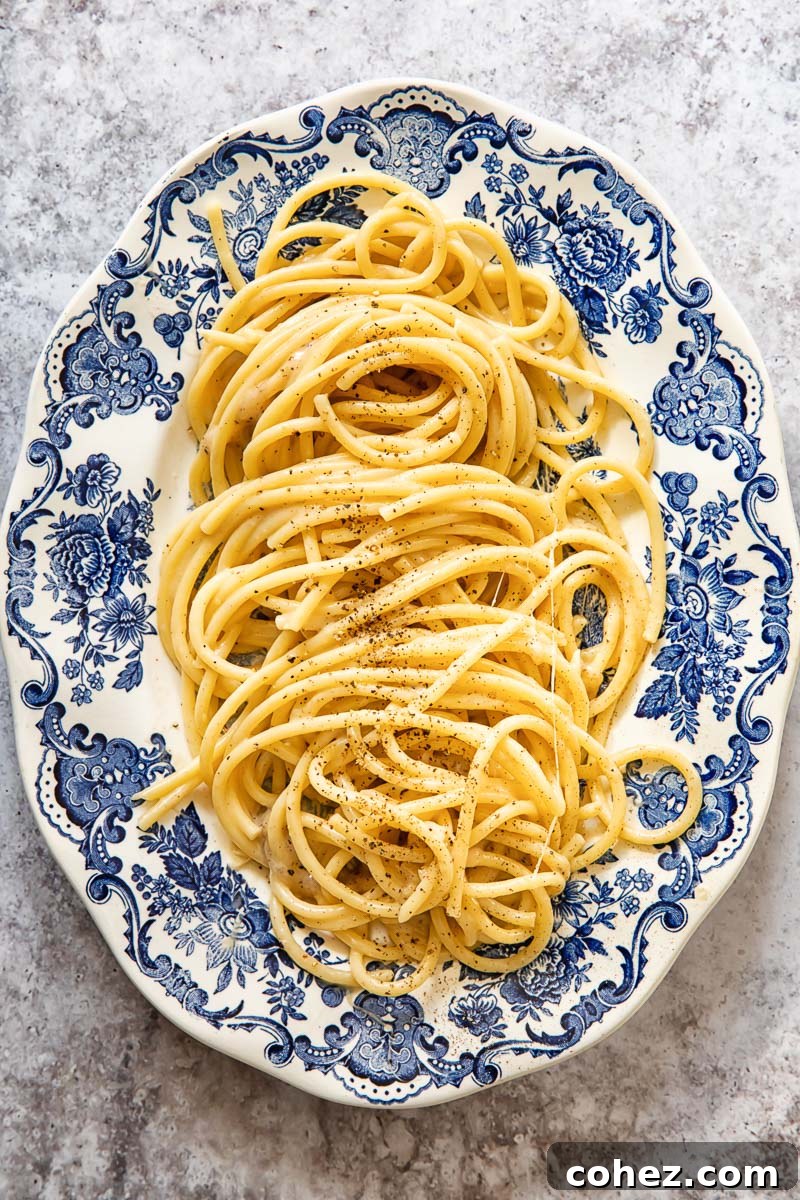
Mastering the Art of the Cacio e Pepe Sauce
While the ingredient list for Cacio e Pepe is deceptively simple, don’t let this fool you into thinking the dish is effortless. Cacio e Pepe is renowned among Italian chefs and home cooks alike for being a surprisingly tricky dish to perfect on the first attempt. Its brilliance lies in a delicate balance and an intricate technique that requires patience and understanding.
So, what makes this Roman staple such a culinary challenge? The secret, and indeed the difficulty, lies in the magical “marriage” between the starchy pasta water and the finely grated salty cheese. These two are often reluctant partners, requiring careful coaxing, a gentle introduction, and precise warming to unite into one smooth, glossy, and impossibly delicious emulsified sauce. This isn’t your standard one-pot wonder where ingredients are simply stirred together; it’s a nuanced dance of temperature and technique.
The keys to truly mastering this exquisite sauce, transforming humble ingredients into a gourmet experience, are threefold:
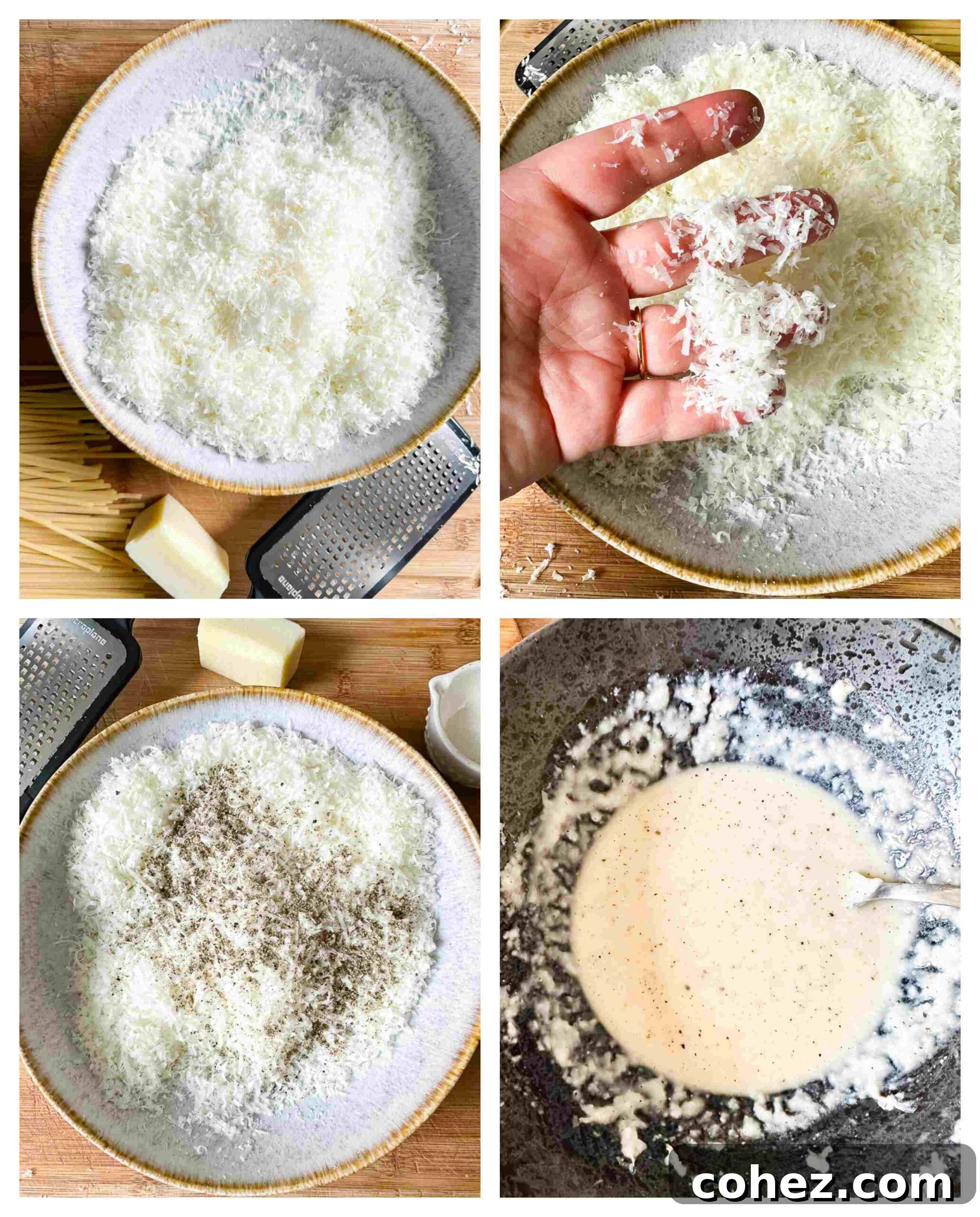
- The Cheese: You need a high-quality, fresh Pecorino Romano, and it must be grated very, very finely. The finer the grate, the more surface area the cheese has, allowing it to melt more readily and smoothly into the sauce without clumping. Think of it as creating a fine powder rather than coarse shreds.
- Warm, Not Hot, Pasta Water: This is perhaps the most critical element. The pasta water must be warm, but never scalding hot. Boiling hot water will shock the cheese, causing it to seize and clump into an unappetizing, stringy mess. Warm water, however, gently coaxes the cheese to melt and emulsify with the starches, forming that signature creamy texture.
- A Comfortably Heated Bowl: The environment in which you combine these two essential ingredients is also vital. Introducing the warm pasta water and finely grated cheese into a pre-warmed bowl helps maintain a consistent, gentle temperature, relaxing them into one another and facilitating a smooth emulsification. A cold bowl will rapidly drop the temperature, hindering the melting process and leading to a clumpy sauce.
Yes, these might seem like overly exaggerated steps for a dish with such a minimal ingredient list. However, I assure you, in the realm of Cacio e Pepe, cutting corners is a recipe for disappointment. Trust me on this one; embrace the precise technique, and you’ll be rewarded with an authentic, velvety Roman delight.
Expert Tips and Notes for Perfect Cacio e Pepe
- Simple ingredients do not equate to a simple dish. I’m not too proud to admit that my first attempt at Cacio e Pepe was a complete failure. And my second wasn’t much better! But remember, the ancient city of Rome was not built in a day, and neither is the mastery of this Roman classic. Patience and practice are your best allies.
- Did I mention the sauce is tricky? The pasta water and cheese truly need some gentle persuading to become friends and form that perfect emulsion. Your primary task is to ensure the conditions are absolutely perfect for this culinary match.
- First, the pasta water must be warm – not boiling hot. This crucial temperature allows the cheese to melt slowly and evenly, preventing it from seizing or clumping.
- Second, these two key ingredients must be introduced and combined in a warm bowl, not directly in a hot stovetop pan. This controlled environment, combined with gentle but continuous whisking, will encourage the elements to merge, emulsify, and ultimately create that pale, silken, and unforgettable sauce.
- If your efforts result in milky water with distinct globs of cheese floating within, I’m afraid you’ve forced the friendship, and the emulsification has gone wrong. While the texture may not be ideal, please, do not despair or discard it! The flavors will still be incredible. I’ve certainly eaten my “failed” attempts with no shame. The true shame would be to waste such delicious ingredients!
- The quantity of black pepper is entirely a matter of personal preference. I find 1 teaspoon of freshly ground black pepper per two portions to be perfectly balanced for my taste, offering a delightful warmth without overwhelming the other flavors. However, if you prefer a more assertive peppery kick, don’t hesitate to give it a few more generous grinds.
- Pecorino Romano remains the authentic and preferred cheese choice for a reason. Its unique texture is finer and more crumbly than the larger-grained Parmigiano Reggiano or Grana Padano, which makes it melt far more willingly and smoothly into the sauce. This melting property is a huge advantage and a key factor in achieving the signature silky consistency of Cacio e Pepe.
Storage and Reheating Bucatini Cacio e Pepe
Bucatini Cacio e Pepe, like many fresh pasta dishes, is truly at its absolute best when eaten immediately, straight from the pan. The delicate emulsion of cheese and pasta water is most stable and creamy when warm. However, if you find yourself with the rare blessing of leftovers – perhaps you underestimated your appetite for this irresistible Roman delight – you can certainly store them.
To store, cover any remaining Cacio e Pepe tightly with cling film or transfer it to an airtight container and refrigerate for up to 2 days. Be aware that the sauce will likely thicken considerably and lose some of its original creaminess upon cooling, as the cheese and starch solidify.
When you’re ready to reheat, the key is to do so gently to help reactivate the sauce. Add a splash of water (a tablespoon or two) to the cold pasta and heat it slowly on the stovetop over low heat, stirring continuously, until warmed through and the sauce begins to loosen. Alternatively, for ultimate convenience, you can microwave it for 40 seconds to 1 minute, depending on your microwave’s power, stirring halfway through and adding a tiny bit of water if needed to bring back some moisture and creaminess.
Explore More Quick & Delicious Pasta Recipes:
- Authentic Spaghetti Carbonara: Another Roman classic, rich with eggs, Pecorino, and guanciale.
- Three-Ingredient Creamy Pasta Sauce: Simple, decadent, and incredibly versatile.
- Easy Homemade Pasta Alfredo: A comforting and rich pasta dish, perfect for busy weeknights.
- Spaghetti alla Siciliana: A vibrant, flavorful pasta dish showcasing Mediterranean ingredients.
Bucatini Cacio e Pepe
By Julia Frey of Vikalinka
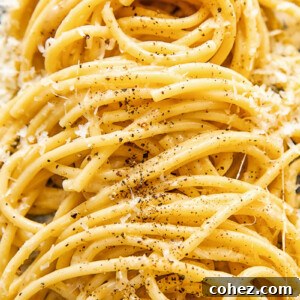
Quite simply, bucatini cacio e pepe is pasta in a sharp cheese and black pepper sauce. A simple and elegant alternative to a tomato-based pasta recipe, and a true Roman classic.
Equipment
- Colander
- Large pot
- Mixing bowl
- Whisk
Ingredients
- 200g / 1/2 lbs bucatini, or spaghetti
- 1 tsp black pepper, freshly ground
- 80g / 3/4 cup / 3 oz Pecorino Romano, very finely grated (or Parmigiano Reggiano if Pecorino is unavailable)
- 1 tbsp butter (optional, for extra richness)
- 170ml / 3/4 cup warm pasta water (reserved from cooking)
Instructions
- Start cooking the pasta in a large pot of boiling, generously salted water. To concentrate the starch, which is vital for the sauce, use about 1/3 less water than you usually would for this amount of pasta. Cook the bucatini according to package instructions until al dente.
- While the pasta cooks, prepare your other ingredients. Grate the Pecorino Romano using the smallest holes on your grater; the cheese needs to be extra fine to achieve a silky smooth sauce. Absolutely do not use pre-grated cheese for this recipe, as it often contains anti-caking agents that hinder emulsification. Grind your black pepper coarsely and measure it out.
- Preheat a separate mixing bowl – this is crucial. You can warm it gently in a low-setting oven or microwave it for approximately one minute. Add the very finely grated cheese and the freshly ground black pepper to this warm bowl. Gradually begin to add the warm pasta water, a little bit at a time, continuously whisking with vigor until you achieve a smooth, creamy sauce that resembles a light béchamel. The cheese should be completely incorporated and melted into the water. Aim for about 170ml (3/4 cup) of warm pasta water in total, adjusting as needed to reach your desired consistency.
- Once your bucatini is al dente, drain it immediately, reserving the warm starchy pasta water. Add the drained pasta directly to the sauce in your warm mixing bowl. Using a pair of tongs or two large spoons, gently but continuously toss and coat the pasta strands until every piece of bucatini is beautifully enveloped in the creamy, peppery sauce. Serve immediately in warm bowls, with an extra grating of Pecorino Romano if desired, and enjoy this authentic taste of Rome.
Nutrition
Carbohydrates: 77g |
Protein: 26g |
Fat: 18g |
Saturated Fat: 11g |
Polyunsaturated Fat: 1g |
Monounsaturated Fat: 5g |
Trans Fat: 0.2g |
Cholesterol: 57mg |
Sodium: 531mg |
Potassium: 272mg |
Fiber: 3g |
Sugar: 3g |
Vitamin A: 346 IU |
Calcium: 453mg |
Iron: 2mg
Nutrition information is automatically calculated, so should only be used as an approximation.