
The Beloved Bialy: A Journey from Eastern Europe to Your Kitchen (Easier Than Bagels!)
There are certain foods that transcend mere sustenance, becoming woven into the fabric of our memories and identity. For me, bagels hold such a place. Moving away from home often means leaving behind culinary comforts, and amongst the top contenders for what I miss most, a perfectly crafted bagel undoubtedly sits high on the list. It’s no wonder then that the very first bite I took upon landing in Canada for Christmas was an everything bagel, generously slathered with herb and garlic cream cheese – a taste of comfort and familiarity.
My journey with bread began with a jolt when I first moved to America. The omnipresent white, spongy, and alarmingly weightless bread often left me disheartened, sticking unpleasantly to the roof of my mouth. I yearned for the robust, crusty loaves I grew up with – bread that offered a satisfying chewiness yet remained wonderfully soft within. However, as a college student living in a dorm, an oven was a luxury, and baking bread felt like an intimidating, unattainable skill.
It was during this period of bread-induced longing that a friend introduced me to a local bagel shop. The word “bagel” was entirely new to my vocabulary, yet the moment I sank my teeth into that chewy, crusty creation, a powerful sense of recognition washed over me. It was a revelation, a flavor and texture that resonated deeply, reminding me of something cherished from my past.
Unveiling the True Origins of Bagels and Their Cousins
While New York City often takes credit for popularizing bagels, thanks to vibrant Jewish immigrant communities, it’s essential to understand that their story begins far earlier and further east. Without delving into a “new world vs. old world” debate, it’s a fascinating historical fact that bagels trace their roots back to Eastern Europe. Here, these beloved ring-shaped breads, known by various names such as “bubliki” or “baranki” in Russia, and countless others across Polish, Ukrainian, and Czech cultures, were born. They represent a rich culinary heritage, a testament to centuries of tradition and innovation in bread making.
Imagine bustling street corners in 1970s Moscow, where vendors proudly displayed piles of freshly baked bubliki, as beautifully captured in a National Geographic photo. This imagery paints a vivid picture of the integral role these chewy, satisfying baked goods played in daily life across the region long before they became a North American breakfast staple. These were not just bread; they were a symbol of home, community, and resilient culinary traditions passed down through generations.
Introducing the Bialy: A Simpler, Equally Delicious Alternative to Bagels
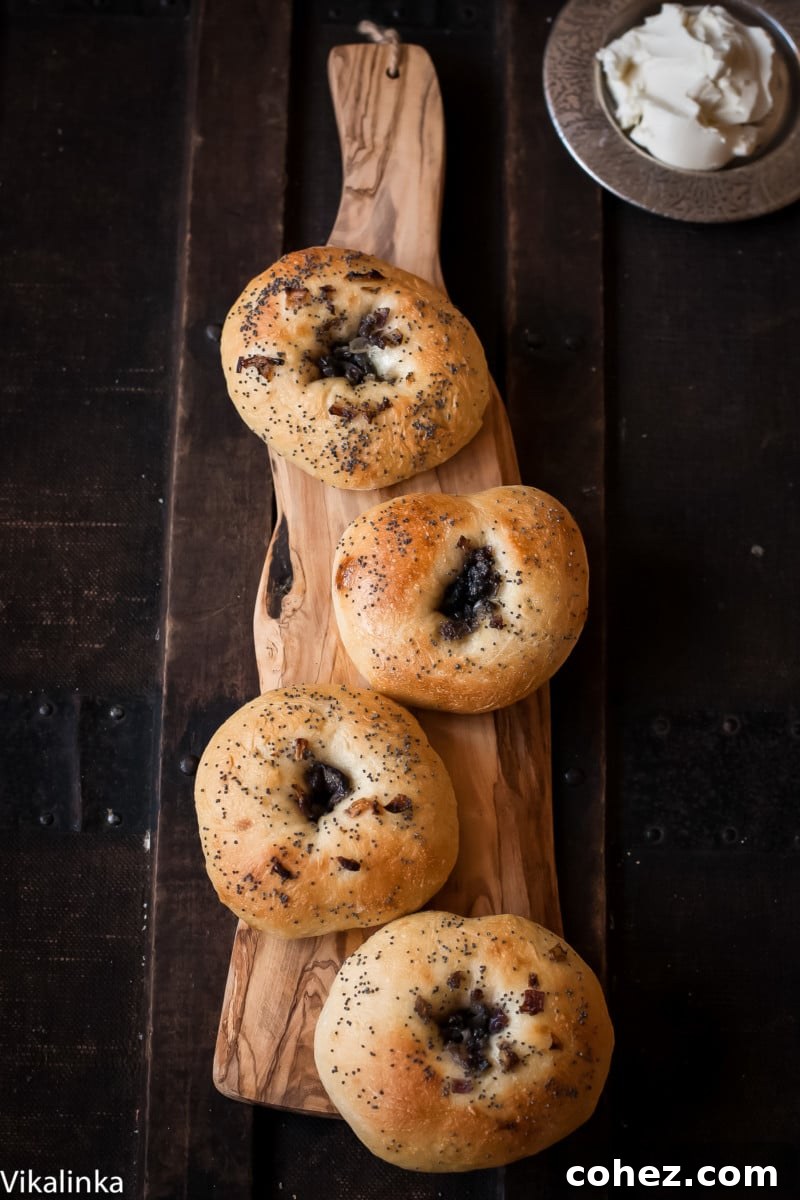
Given this rich history, you might wonder what a Bialy recipe has to do with bagels. Well, these savory onion and poppyseed buns are indeed close cousins to bagels, sharing a similar heritage and a delightfully chewy texture. However, Bialys offer a distinct advantage for the home baker: they are significantly easier to make at home. Unlike bagels, Bialys skip the boiling step, simplifying the process without compromising on flavor or texture. This makes them an ideal project for anyone eager to try their hand at baking authentic Eastern European-style bread without the extra fuss.
Beyond their ease of preparation, Bialys boast another significant benefit: their freshness. While bagels are arguably at their peak for only about 24 hours, Bialys miraculously retain their delightful texture and flavor for days, making them perfect for meal prep or a week’s worth of delicious sandwiches. They are truly versatile, wonderful on their own, with a generous schmear of cream cheese and a fresh cup of coffee in the morning, or as the perfect foundation for your favorite sandwich fillings.
Mastering the Chewy Crust: A Home Baker’s Secret
One of the most elusive qualities of artisanal bread, especially bagels and bialys, is that coveted chewy crust. Commercial ovens achieve this effortlessly through consistent, trapped steam, which is responsible for the wonderful “chew” we all adore. For many home bakers, myself included, replicating this environment can be a challenge, especially with a smaller-than-average oven (mine, for example, is roughly two-thirds the size of a standard North American oven).
But fear not, achieving a beautifully chewy crust at home is absolutely possible! The secret lies in creating your own steam bath. Here’s how: before preheating your oven, place a rimmed baking sheet filled about one-third of the way with water on the lowest rack of your oven. As your oven heats and your bialys bake, the water will produce a steady stream of steam, transforming your buns with that irresistible, deliciously chewy crust. This simple trick elevates homemade bread to a professional standard, proving that you don’t need a commercial bakery setup to create exceptional results.
The dough for these Bialys is surprisingly simple to prepare, yet it yields exceptionally airy buns with that coveted slightly chewy crust – pure beauty in every bite! The process is straightforward, making it an excellent recipe for bakers of all skill levels. We often find ourselves devouring about half the batch as soon as they emerge from the oven, unable to resist their fresh-baked aroma and incredible taste. Fortunately, this recipe is generous, yielding approximately 18 buns, ensuring plenty to last throughout the week. As I mentioned, these Bialys hold up remarkably well; my partner, Brad, regularly makes sandwiches with them for work, and they remain absolutely delightful even on the fourth day.
Savoury Onion and Poppyseed Buns {Bialy}
Julia Frey of Vikalinka
15
10
3
25
18
buns
Ingredients
For the Dough
- 950 g / 7.5 cups bread flour, I recommend using Canadian bread flour for its high protein content
- 5 tsp sea salt
- 2 tsp active dry yeast
- 710 ml / 3 cups warm water
For the Savoury Onion and Poppyseed Filling
- 2 tbsp olive oil
- 1 large onion, finely chopped (red onion works beautifully for a touch of color and sweetness)
- 1 tbsp poppy seeds
Instructions
-
In the bowl of a stand mixer fitted with a dough hook attachment, whisk together the bread flour, sea salt, and dry yeast for a few seconds until well combined. Gradually add the warm water and mix on low speed until a shaggy dough forms, then increase speed to medium and knead for approximately 5 minutes. The dough should become elastic and pull away cleanly from the sides of the mixing bowl. Cover the bowl tightly with plastic wrap and let it rise in a warm, draft-free place for about 2 hours, or until it has visibly doubled in size.
-
Gently turn the risen dough out onto a lightly floured surface. Form the dough into a cohesive ball. Using a sharp knife or a dough scraper, portion the dough into approximately 18 golf ball-sized pieces. These don’t need to be perfectly uniform, but aim for consistency. Cover the dough pieces with a clean kitchen towel or plastic wrap and let them rest for 1 hour. This resting period is crucial for relaxing the gluten, making the dough easier to shape.
-
While the dough rests, prepare the savory onion and poppyseed filling. Heat the olive oil in a large skillet over low heat. Add the finely chopped onion and cook gently for 7-10 minutes, stirring occasionally, until the onion becomes very soft and translucent but not browned. This slow cooking brings out the natural sweetness of the onion. Stir in the poppy seeds and mix well. Remove the pan from the heat and set aside to cool slightly.
-
Preheat your oven to a high temperature of 500 F (260 C). Simultaneously, prepare your steam bath: fill a rimmed baking sheet one-third of the way with water and place it on the lowest rack of your preheating oven. This will create the crucial steam needed for that signature chewy crust.
-
Once rested, take a dough ball and place it on your lightly floured surface. Using your thumb, create a deep indent in the center of the ball. Then, gently pull the opposite sides of the dough ball outwards to stretch and enlarge the indentation. The center indentation should be very thin, almost translucent, but be careful not to tear through the dough. Fill the middle of each bun with approximately 1/2 teaspoon of the cooled onion and poppyseed filling.
-
Carefully transfer the shaped bialys onto baking sheets lined with parchment paper, leaving enough space between them for even baking. If desired, sprinkle a little more poppy seeds over the tops for an extra burst of flavor and visual appeal. Place the baking sheet with bialys on a rack positioned in the middle of your preheated oven. Bake for 8-12 minutes, or until the bialys are golden brown and cooked through. The steam from the water bath will work its magic, giving them that perfect chewy exterior.
-
Once baked, transfer the bialys to a wire rack to cool slightly. Repeat the baking process with the remaining dough and filling until all your delicious bialys are baked. These are best enjoyed warm, but as mentioned, they remain wonderfully fresh for several days, making them perfect for future meals!
Nutrition Facts (per bun)
Calories:
211
kcal
|
Carbohydrates:
39
g
|
Protein:
7
g
|
Fat:
3
g
|
Saturated Fat:
1
g
|
Sodium:
650
mg
|
Potassium:
77
mg
|
Fiber:
2
g
|
Sugar:
1
g
|
Vitamin C:
1
mg
|
Calcium:
17
mg
|
Iron:
1
mg
Nutrition information is automatically calculated and should only be used as an approximation.
Tried this recipe?
Let us know how it was!