
(Thank you Arla Fibre for sponsoring this post and keeping the Vikalinka kitchen in business!)
Unlock a Healthier You: The Essential Role of Dietary Fiber in Your Daily Diet
Have you ever paused to consider your daily fiber consumption? If your immediate answer was “no,” you’re certainly not alone. For many, fiber only truly enters the nutritional spotlight when specific dietary changes are undertaken, like a low-carb regimen. During such times, its critical role in maintaining digestive regularity and overall well-being becomes undeniably apparent. It’s an essential nutrient, vital for keeping our systems functioning smoothly and contributing significantly to that feeling of fitness and vitality we all strive for.

My Eye-Opening Journey into the World of Fiber
My own understanding of fiber underwent a significant transformation recently, thanks to an unexpected invitation. Last week, I found myself attending an immersive dinner experience. Initially, I simply saw it as an opportunity for a pleasant evening out. Little did I know, the entire culinary event was meticulously designed around one unassuming, yet incredibly powerful, ingredient: fiber. Had I known the theme beforehand, I might have hesitated, as “fiber” rarely conjures images of excitement or culinary innovation. Yet, sometimes the most valuable lessons come from the least expected places.
And indeed, I walked away from that dinner profoundly enlightened. One of the most startling revelations was learning the minimum daily requirement for fiber consumption: a robust 30 grams. Prior to this, I confess I was completely unaware of this specific target, and frankly, I believed my diet, rich in fruits and vegetables as a food blogger’s often is, provided ample amounts. But here’s the interesting paradox: while I thought I was doing well, the average Brit consumes a mere 18 grams daily, a stark contrast to the recommended intake. This highlights a significant nutritional gap that many of us, even those with health-conscious habits, might be overlooking.
The Surprising Truth About Fiber in Our Food
The dinner also unveiled a crucial insight: not all fruits and vegetables are created equal when it comes to their fiber content. This concept was truly eye-opening. For instance, which do you instinctively think has more fiber: raspberries or grapes? Or, consider nuts and seeds: do cashews pack a bigger fiber punch than sesame seeds?

Despite considering myself reasonably knowledgeable about food and nutrition, I was wrong on both counts. It turns out that making informed food choices can make all the difference in effortlessly reaching that 30-gram daily target. The dinner itself was a brilliant demonstration of this principle. Unbeknownst to us, we were served two distinct three-course meals that appeared almost identical. One was carefully crafted to be low in fiber, while the other was a “High-Fi” — high fiber — masterpiece. I had the pleasure of experiencing the latter, and I can attest, it was absolutely delicious and incredibly inventive.
Culinary Innovation: A High-Fiber Feast
The ingenuity of the high-fiber menu lay in its ability to integrate significant fiber content without sacrificing flavor or appeal. Each course was a masterclass in subtle swaps that transformed everyday dishes into nutritional powerhouses.
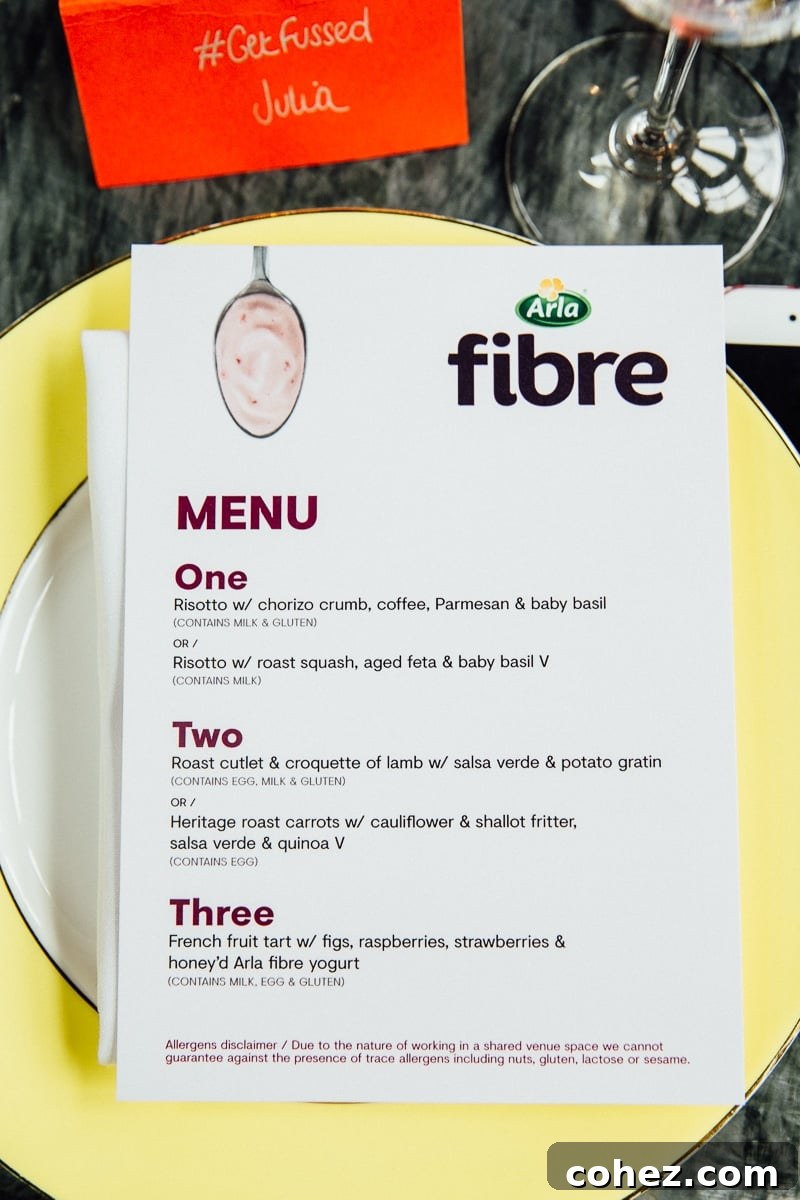
The Starter: Coffee and Chorizo Risotto with a Whole Grain Twist
Our gastronomic journey began with a coffee and chorizo-flavored risotto. On the surface, one might not immediately associate risotto with high fiber. However, the secret lay in a simple, yet impactful, substitution: the use of brown rice instead of white. This single change drastically elevated the fiber content. Brown rice, a whole grain, retains its bran and germ, which are rich in fiber, vitamins, and minerals, unlike its refined white counterpart. It provided a delightful chewiness and a deeper, nuttier flavor that complemented the savory chorizo beautifully. This demonstrated that integrating more fiber doesn’t require a complete overhaul of your favorite meals; often, it’s about making smart, informed ingredient choices.

The Main Course: Lamb Croquettes and the “Brown is Better” Principle
For the second course, we savored a perfectly roasted cutlet accompanied by lamb croquettes. Again, it might seem counterintuitive to find significant fiber in a meat-centric dish. The brilliance, however, was in the croquettes’ breading. Instead of using refined white breadcrumbs, wholemeal, or brown, breadcrumbs were utilized. This seemingly minor tweak injected a substantial amount of additional fiber into the dish. Wholemeal bread, retaining its entire grain, provides a denser, more satisfying texture and significantly more fiber compared to white bread. This reiterated a powerful theme evident throughout the meal: when it comes to grains, “brown is better than white.” This simple principle can guide countless healthy substitutions in your daily cooking, from pasta to cereals.

The Sweet Finish: A Decadent Fruit and Yogurt Tart with Arla Fibre
To conclude our exquisite meal, we were presented with a visually stunning and utterly decadent fruit and yogurt tart. This dessert, far from being just a sweet indulgence, was a fiber powerhouse. Its high fiber content was achieved through multiple strategic choices: the pastry was crafted with wholemeal flour, and it featured fiber-rich fruits like succulent berries and figs. But the most significant contributor to its impressive fiber tally was the innovative new Arla Fibre yogurt.

Introducing Arla Fibre Yogurt: Bridging the Fiber Gap Effortlessly
The presence of Arla Fibre yogurt in the dessert wasn’t just a culinary choice; it represented a direct response to a widespread nutritional challenge. Arla recognized a critical research finding: most people simply do not consume nearly enough fiber in their daily diets. In response, they developed a pioneering line of yogurt specifically designed to be rich in fiber, making it incredibly easy for consumers to boost their intake without compromising on taste or texture.
What sets Arla Fibre yogurt apart is its ingenious formulation. Unlike attempting to manually add ingredients like bran to your yogurt for extra fiber, which can often result in a gritty or unappealing texture, Arla Fibre maintains the smooth, creamy consistency and delicious taste that Arla yogurts are known for. Each 150g pot of Arla Fibre yogurt delivers a substantial 4.7g of fiber, instantly providing approximately one-sixth of your recommended daily intake. This makes it an incredibly convenient and enjoyable way to ensure you’re moving closer to that vital 30g target, whether enjoyed on its own, mixed into a smoothie, or incorporated into recipes like the amazing tart we enjoyed.
More Than Just Fiber: A Family’s Trust in Arla Dairy
My family’s appreciation for Arla’s commitment to quality and innovation extends beyond just their new fiber-enriched line. We have been devoted fans of Arla’s lactofree dairy products for years. My son, who is lactose intolerant, has been able to reintroduce many beloved dairy items into his diet thanks to Arla’s lactose-free milk and yogurt, allowing him to enjoy foods he had long given up. This personal experience has built a strong foundation of trust and reliability in the Arla brand.
Given our positive history and the clear nutritional benefits, adding Arla Fibre yogurt to my weekly shopping list is an absolute no-brainer. It represents a delicious, effortless, and effective solution to a common dietary shortfall. It’s a simple swap that can make a significant difference in daily nutrition, contributing to better digestive health, sustained energy levels, and overall well-being. Incorporating products like Arla Fibre into your routine isn’t just about meeting a number; it’s about embracing a more conscious and healthier approach to eating, making it easier than ever to feel your best every single day.