
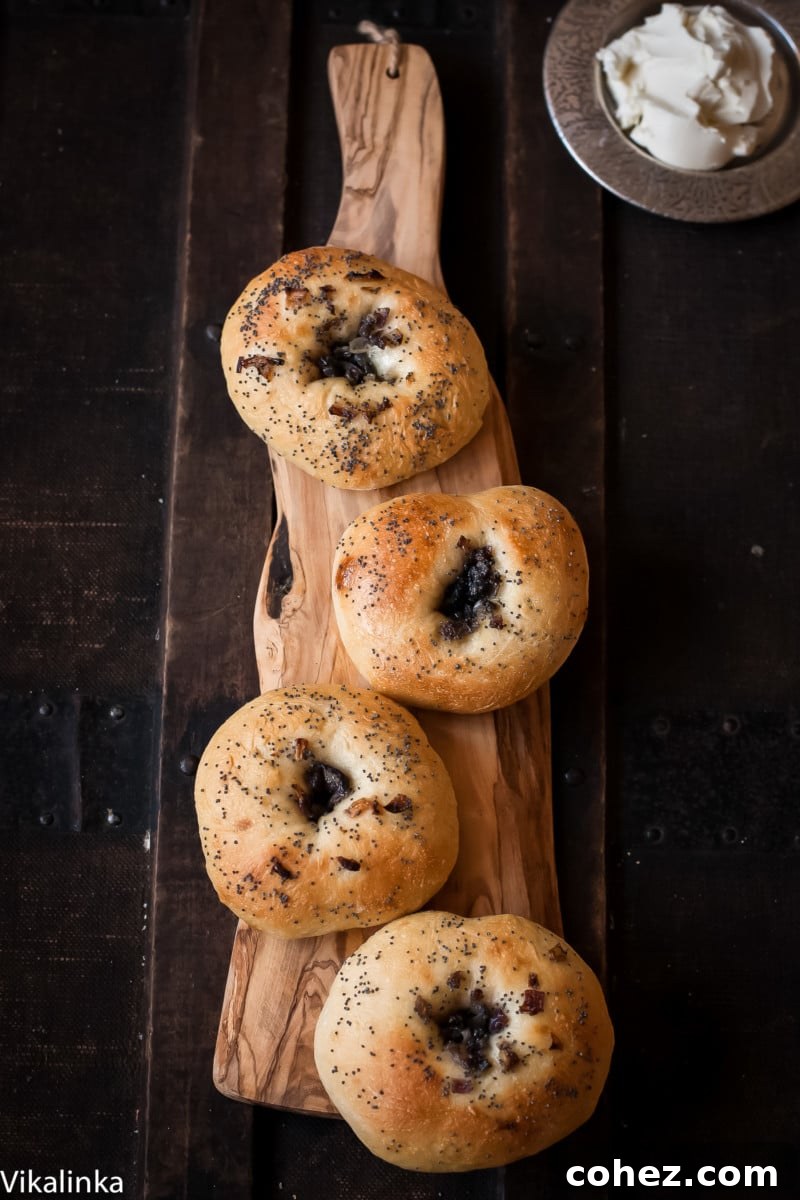
Authentic Savoury Onion and Poppyseed Bialy Buns: A Homemade Eastern European Delight
Among the many comforting tastes of home, authentic bagels hold a top spot in my heart. It’s no wonder that the first thing I savored upon touching down in Canada last Christmas was an “everything bagel” generously spread with herb and garlic cream cheese. This simple pleasure speaks volumes about the deep connection I have with truly great bread, a connection that blossomed during my early days far from home.
My journey with bread began years ago when I first moved to America for college. I distinctly remember my dismay at the typical bread available – often white, overwhelmingly spongy, and surprisingly weightless. It lacked the satisfying chew and robust flavor I cherished, often sticking unpleasantly to the roof of my mouth. I longed for the crusty, yet subtly chewy and pillowy soft loaves I grew up with. Unfortunately, living in a dorm meant no access to an oven, and even worse, I had absolutely no idea how to bake bread myself.
It was during this period of culinary longing that a friend, on a casual outing, introduced me to a local bagel shop. The word “bagel” was entirely new to my vocabulary, yet the moment I took that first bite, an undeniable sense of recognition washed over me. The texture, the taste, the unique chew – it all felt incredibly familiar, as if I had encountered this delightful bread before. It was a revelation, a true taste of home I never expected to find in a new country.
The Rich History of Bagels and Their Eastern European Cousins
Bagels are often strongly associated with New York City, largely due to the vibrant Jewish immigrant communities who popularized them there. However, it’s essential to clarify – and I preface this by saying I’m not initiating an “Old World vs. New World” culinary debate – that New York is not where bagels originated. Their roots lie much deeper, embedded in the culinary traditions of Eastern Europe.
Jewish immigrants brought bagels with them from countries like Poland, Ukraine, and, of course, Russia, where they are known by various names such as “bubliki” or “baranki.” These ring-shaped, often sweetened or savory breads have been a staple in Eastern European diets for centuries, predating their American popularity. The chewy, boiled-then-baked characteristic that defines a bagel is a testament to this rich heritage. We, in a sense, “own” bagels in terms of their historical lineage and cultural genesis, a proud tradition shared across many Slavic and Ashkenazi Jewish communities.
For a glimpse into this historical context, consider an iconic National Geographic photo from 1970s Moscow, depicting a bustling street stand laden with bubliki. This image beautifully illustrates the everyday presence and enduring popularity of these beloved ring-shaped breads in their ancestral homeland.
Meet the Bialy: Bagel’s Simpler, More Versatile Cousin
Now, you might be wondering, what does a Bialy recipe have to do with bagels? Well, these savoury onion and poppyseed buns are indeed close cousins to bagels, sharing a similar heritage and a beloved place in Eastern European cuisine. However, Bialys offer several distinct advantages, especially for the home baker, making them an excellent alternative to their ring-shaped relatives.
Unlike bagels, which require an extra boiling step that can be intimidating for some home cooks, Bialys are baked directly in the oven. This simpler process makes them significantly easier to master at home. Furthermore, Bialys boast superior longevity; they remain delightfully fresh for several days, a stark contrast to bagels that are often best enjoyed within 24 hours of baking. This extended freshness makes them incredibly practical for meal prepping or simply enjoying throughout the week.
But the true magic of the Bialy lies in its design: it’s truly “made” for sandwiches. Its flat, indented center, usually filled with a savory mixture of onions and poppy seeds, creates a natural pocket that perfectly cradles your favorite fillings. Imagine a deli sandwich built on a soft, slightly chewy Bialy – pure perfection! Beyond sandwiches, they are also utterly delicious simply toasted with a schmear of cream cheese, perhaps a touch of lox, or enjoyed alongside a fresh cup of coffee for a truly comforting breakfast.
Mastering the Chewy Crust at Home: The Secret to Perfect Bialys
One of the hallmarks of a great Bialy, much like a good bagel, is that wonderfully chewy crust. This texture is typically achieved in commercial ovens, where steam is easily trapped, creating the ideal environment for that sought-after “chew.” Replicating this professional result in a standard home oven can be a challenge, especially if your oven is on the smaller side – mine, for instance, is about two-thirds the size of a typical North American oven.
However, there’s a simple yet highly effective trick you can employ to create that steamy environment right in your own kitchen: place a rimmed baking sheet filled about one-third with water on the lower rack of your oven while your Bialys bake. As the water heats, it will produce steam, which will circulate around your buns. This steam slows down the crust’s development, allowing the interior of the dough to fully expand and creating a beautiful, deliciously chewy exterior. It’s a game-changer for homemade chewy breads!
The Bialy Baking Experience: Simplicity and Satisfaction
The dough for these Bialys is remarkably straightforward to prepare, yielding incredibly airy buns with that coveted slightly chewy crust. It’s a pure beauty in terms of baking simplicity and delicious outcome. From start to finish, the process is rewarding, culminating in a batch of fresh, aromatic buns that are hard to resist.
When I first made these, my family and I practically devoured half the batch as soon as they emerged from the oven – the aroma alone is enough to tempt anyone! Fortunately, this generous recipe makes about 18 buns, ensuring there’s plenty to go around for the rest of the week. As I mentioned, my husband Brad packed them for work lunches, and even on day four, they were absolutely delightful, proving their exceptional staying power and versatility.
This recipe for Savoury Onion and Poppyseed Bialy Buns isn’t just about baking; it’s about bringing a piece of rich culinary history into your home. It’s about creating moments of pure comfort and satisfaction with simple, wholesome ingredients. Whether you’re a seasoned baker or new to the world of bread making, these Bialys are a fantastic project that promises delicious rewards. They’re perfect for a hearty breakfast, a satisfying lunch sandwich, or a delightful snack any time of day. Enjoy the process, and more importantly, enjoy the incredible taste of these homemade Eastern European treats!
★
★
★
★
Savoury Onion and Poppyseed Buns {Bialy}
Julia Frey of Vikalinka
15 mins
10 mins
3 hrs 25 mins
18 buns
Print Recipe
Ingredients
- 950 g bread flour (approx. 7.5 cups, Canadian bread flour recommended)
- 5 tsp sea salt
- 2 tsp dry yeast
- 710 ml water (approx. 3 cups)
For the filling
- 2 tbsp olive oil
- 1 large onion (red onion works great)
- 1 tbsp poppy seeds
Instructions
-
Whisk the flour, salt, and yeast together in the bowl of a stand mixer fitted with a dough hook attachment. Mix for a few seconds to combine. Add the water and continue mixing for approximately 5 minutes until an elastic dough forms. By the end of this process, the dough should cleanly pull away from the sides of your mixing bowl. Cover the bowl with plastic wrap and let the dough rise in a warm place for 2 hours, or until it has doubled in size.
-
Gently turn the risen dough out onto a lightly floured surface. Form it into a cohesive ball. Using a sharp knife or bench scraper, portion the dough into roughly golf ball-sized pieces. Cover the pieces with a clean kitchen towel or plastic wrap and let them rest for 1 hour. This resting period helps the gluten relax, making the dough easier to shape.
-
While the dough rests, prepare the savoury filling. Heat the olive oil in a large pan over low heat. Add the chopped onion (red onion provides a lovely flavor and color) and cook gently for 7-10 minutes, or until softened and translucent, but not browned. Stir in the poppy seeds and mix well. Remove the pan from the heat and set aside to cool slightly.
-
Preheat your oven to 500 F (260 C). Place a rimmed baking sheet filled about one-third with water on the lowest rack of your oven. This will create the steam needed for a chewy crust.
-
To shape each Bialy: Take one dough ball and place it on your lightly floured surface. Using your thumb, press firmly into the center of the dough to create a deep indentation. Then, gently pull and stretch the opposite sides of the dough ball outwards to widen the indentation. The center should be very thin, but take care not to tear the dough. Fill the middle of each bun with approximately 1/2 teaspoon of the prepared onion and poppyseed filling.
-
Carefully transfer the shaped Bialys onto baking sheets lined with parchment paper, leaving some space between each. Sprinkle a little extra poppy seeds over the tops, if desired, for added texture and visual appeal. Place the baking sheet with Bialys on a rack positioned in the middle of the preheated oven. Bake for 8-12 minutes, or until golden brown and cooked through. Once baked, transfer the Bialys to a wire rack to cool completely.
-
Repeat the baking process until all of your delicious Bialys are baked. Serve warm or at room temperature, and enjoy the homemade goodness!
Nutrition
Calories:
211kcal
|
Carbohydrates:
39g
|
Protein:
7g
|
Fat:
3g
|
Saturated Fat:
1g
|
Sodium:
650mg
|
Potassium:
77mg
|
Fiber:
2g
|
Sugar:
1g
|
Vitamin C:
1mg
|
Calcium:
17mg
|
Iron:
1mg
Nutrition information is automatically calculated, so should only be used as an approximation.
Tried this recipe?
Let us know how it was!